Long Covid · NICE NG188 cited · Margaret R. (fictionalised)
This is the letter your GP will receive.
Not a template. Not a sketch. The structure, the citations, the asks, and the deadline are exactly what the tool produces for a real Long Covid submission.
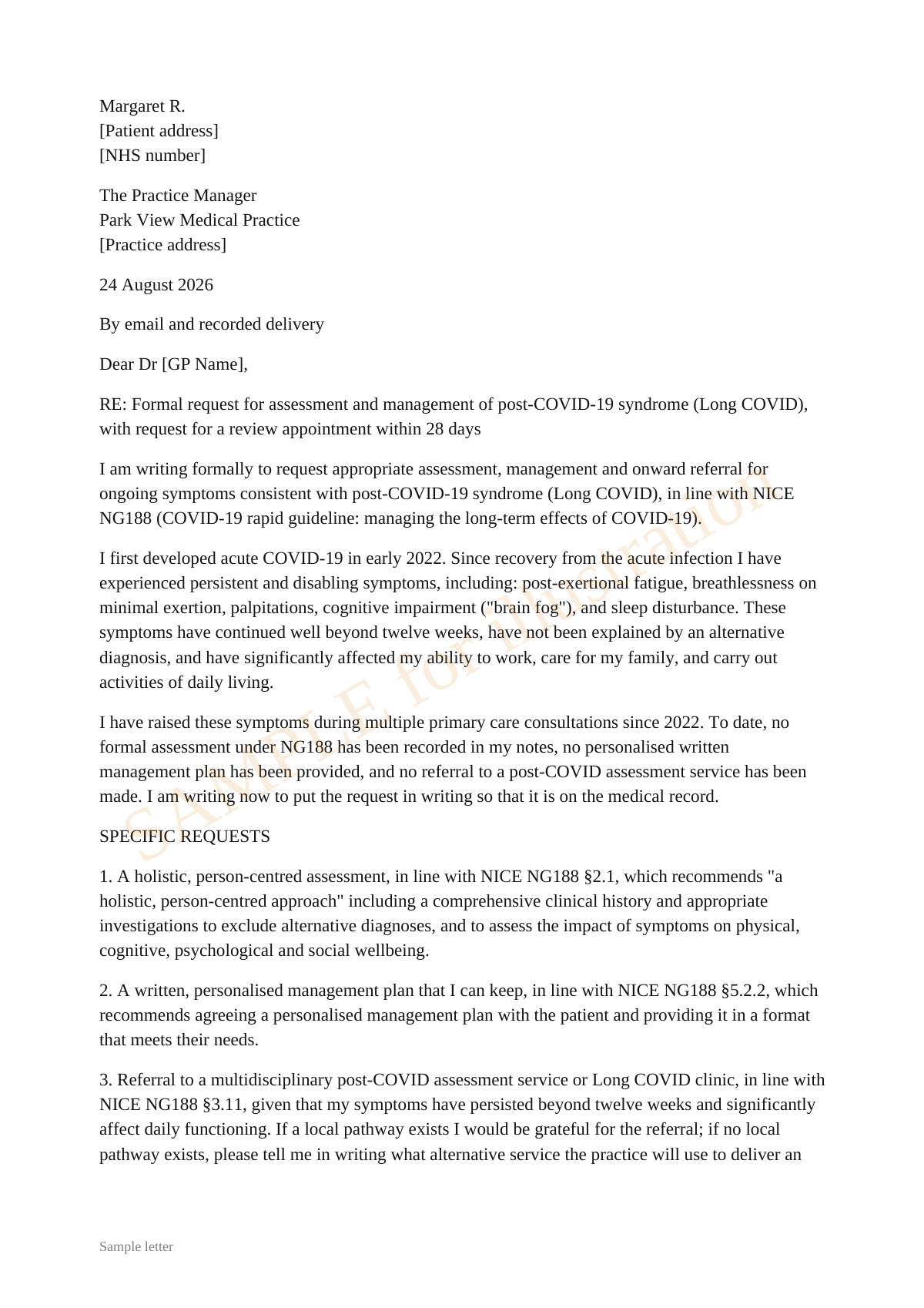
“A holistic, person-centred assessment, in line with NICE NG188 §2.1, including a comprehensive clinical history and appropriate investigations.”
“A written, personalised management plan that I can keep, in line with NICE NG188 §5.2.2.”
“A review appointment or telephone consultation within 28 days to discuss this letter, with the outcome added to my medical record: what has been actioned, what has been declined and why, and the date of any referral made.”
Verbal asks leave no trace.
A letter sits permanently on the medical record. The GP knows it. So does the next reviewer.
The guideline is named, not implied.
The letter quotes the recommendation by clause, dates the request, and asks for the reason to be recorded if the guideline is not followed.
Once it’s in writing, it goes on your record.
28 days asked. If they don’t reply, your pack already includes the Stage 1 ICB complaint.
PIP refusal · reg 4(2A) and reg 7 SI 2013/377 cited · Dawn Ellison (synthetic)
And this is the letter the DWP receives.
Doc 1 of the Mandatory Reconsideration pack, reproduced in the shape the tool actually builds it: a point by point response to the decision, activity by activity, in the statutory descriptor language. Every detail below is invented. It is not a customer letter, and it is not tidied up for display.
Dawn Ellison
[Your National Insurance number]
[Address at the top of your decision letter]
14 August 2026

Re: Mandatory Reconsideration request for the PIP decision dated 21 July 2026

I am requesting a Mandatory Reconsideration of the PIP decision dated 21 July 2026. I ask that this letter be treated as my formal Mandatory Reconsideration request.

My conditions are fibromyalgia and generalised anxiety disorder, both diagnosed in 2021. I have set out below, activity by activity, why I say the descriptors chosen in the decision do not reflect how I carry out these activities.

Preparing food. I cannot prepare and cook a simple meal without using an aid or appliance. I use a perching stool because I cannot stand at the hob for the time a meal takes, and I use pre-chopped vegetables because I cannot grip a knife safely when my hands are stiff. On the days I attempt this without help I stop partway through. I ask that the descriptor chosen be reconsidered in the light of the aids I actually use rather than the fact that I can, on a good day, put food in a microwave.

Washing and bathing. I need to use an aid or appliance to be able to wash or bathe. I have a grab rail and a shower seat, and I cannot get in or out of the bath at all. Where washing is attempted standing and unaided I am unsteady, which is the risk the reliability test is directed at.

Managing therapy or monitoring a health condition. I need supervision or assistance to manage my medication and my exercise programme. I use a weekly pill organiser filled by my partner, because when my pain is bad I lose track of what I have taken and have twice taken a double dose.

Moving around. I cannot, without being accompanied, walk more than 50 metres and stand and then move that distance. I stop because of pain and because my legs give way, not because of breathlessness. I ask that the distance recorded in the decision be reconsidered against the standard set out below rather than against a single attempt on one day.

Reliability. Under reg 4(2A) SI 2013/377 as amended, I can only be treated as able to carry out an activity if I can do so "safely; to an acceptable standard; repeatedly; and within a reasonable time period". Safely means in a manner unlikely to cause harm to me or to another person. Repeatedly means as often as the activity is reasonably required to be completed. Within a reasonable time period means no more than twice as long as the maximum period that a person without a physical or mental condition would normally take. My difficulty is not that these activities are impossible once. It is that they are not repeatable, and that they take me far longer than they should.

Required period. Reg 7 SI 2013/377 provides that a descriptor applies where it is satisfied on more than 50% of the days of the required period. I ask the decision maker to apply that test to the evidence on my file, including my own account of how my symptoms vary, rather than to a single assessment appointment.

The assessment. To the extent that the decision relies on observations recorded at the assessment, I ask that the weight given to them be reconsidered. Insofar as the report infers from my sitting through the appointment that I can sit or stand comfortably for that period, that inference does not hold: I was in pain throughout and I spent the following two days in bed. I do not know what was written, which is why I make the request in the next paragraph.

I request a copy of the written assessment report (the PA4) relied upon in this decision, so that I can respond to what it actually says. If the report is not sent to me before this reconsideration is decided, I ask that this letter be read as a request to respond once I have seen it.

I have also enclosed, or will send separately, the following: a letter from my GP dated 3 June 2026, my repeat prescription list, and a two week symptom diary.

Please reconsider the decision of 21 July 2026 on the basis set out above. I can be contacted at the address on the decision letter if anything further is needed.

Yours faithfully,

Dawn Ellison

This letter is a request for reconsideration written from my own account of my condition. It is not legal or medical advice.
Synthetic claimant · bracketed lines are filled in by hand
One paragraph per disputed activity, each one in the statutory descriptor language for that activity, so the decision maker can match it to the scoring test.
"safely; to an acceptable standard; repeatedly; and within a reasonable time period", attributed to reg 4(2A) SI 2013/377 as amended, with the reg 4(4) definitions attached only where they exist.
Reg 7 is named and the decision maker is asked to apply it. The letter never claims the test is met, never predicts a decision, and never invents a frequency the claimant did not give.
How a mandatory reconsideration works
The pack also contains an evidence checklist, a submission guide, and a request for the written assessment report. A reconsideration request is a request. Nothing on this page says what the decision maker will do with it, and no document we produce is legal or medical advice.
NHS-cited letter from a 3-minute intake form · Free redraft, or a refund within 180 days for any reason
This is a fictionalised case. Margaret R. is a composite, but the structure, citations and asks are exactly what the tool produces for a real Long Covid submission. If your GP still doesn't reply, the Stage 1 ICB complaint and Stage 2 PHSO complaint come in the same email.
The Finally Seen team
Sample document for illustration. Watermarked accordingly. Real letters generated for paying users are personalised to the submission, retrieve the relevant NHS guidelines for the presenting symptoms, and pass through verification before being emailed. See how it works.